
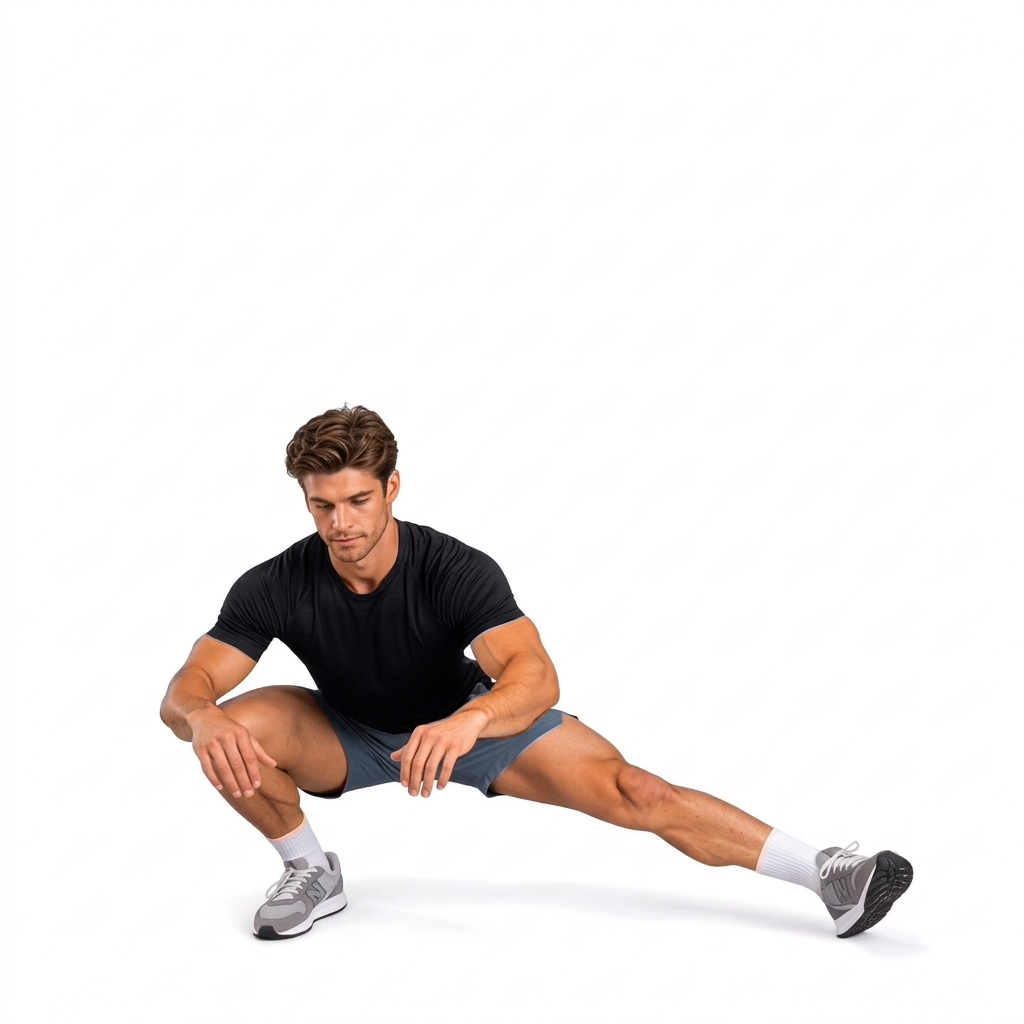

Wide stance, one side at a time, no gear needed. Here is the setup, and why each cue matters.
How to do it
- Stand with your feet very wide.
- Shift your weight to one side and sit into that hip.
- Keep the other leg straight with toes pointing up.
- Go as deep as you can with your heel down.
- Push back to the middle and switch sides.
Where you should feel it
Feel the burn in your quads and glutes. If you feel it in your knees or lower back, check your form.
Breathing
Breathe out through the hard part and in on the way back. Keep breathing the whole set.
Common mistakes
- Heel lifting. Keep the bent leg's heel down. Your depth stops where your heel stays flat.
- Toes pointing forward on the straight leg. Point them up so the inside of that leg can stretch.
- Folding forward. Keep your chest up as you sit into the hip.
- Going too deep too soon. Hold a support and take some weight through your hands until you own the bottom.
Research note
A 2018 study compared a side lunge, a close cousin of the Cossack squat, with a half squat. It split 27 young team sport players into two groups, and both trained on a flywheel machine twice a week for 6 weeks. The side lunge group grew their inner thigh muscle (adductor) by 11.1%, more than the squat group.
Source: Núñez FJ, Santalla A, Carrasquila I, Asian JA, Reina JI, Suarez-Arrones LJ. PLoS One, 2018. PubMed 29590139
Start your free trial.
Your workouts adapt to your day, your energy and your goals. Try SwipeHealth free.
Start your free trial