

Key takeaways
- Do your next workout within two days.
- Go a little lighter and stop sets with two or three reps left.
- Keep a short minimum workout for busy weeks, with the weights still heavy.
- Plan when and where your next workout happens, and put it on your calendar.
Missed a week of workouts? The short answer
Do your next workout in the next two days. Use the same exercises you did before, go a little lighter, and stop each set while you could still do a few more reps. The plan below aims to get you close to your normal weights by your third workout back.
Why: a week or two off costs you very little strength. What you lose tends to come back faster than it took to build the first time.
Next: the plan below shows what to do in each of your first three workouts back.
If your break was because you were sick, hurt, had surgery or a baby, or you started a new medicine, check with your doctor before you start back.
What you actually lost in a week or two
Two weeks off can feel like starting from scratch. It isn't.
A review of research on short breaks (under 4 weeks) found that strength drops only a little in that time.[1] Your cardio fitness, meaning how long you can keep going before you get out of breath, slips faster. The cardio drop was biggest in highly trained athletes. It was milder in people who had only been training for a short time.
The catch is time. A large analysis of 103 studies found that the longer people stopped training, the more strength and power (how fast you can push or lift) they lost. People over 65 lost more.[2] So getting back soon matters more than getting back perfectly.

It comes back faster than it took to build
In a 2024 trial, 55 adults who didn't lift weights were split into two groups.[3] One group lifted for 10 weeks, stopped for 10 weeks, then lifted for 10 more. The other group waited 10 weeks, then lifted for 20 weeks straight. Both groups trained twice a week.
The group that took a break lost some strength and muscle while they were off. But in their first 5 weeks back, they gained leg strength and muscle size faster than the other group did in its first 5 weeks of lifting. After 30 weeks, both groups ended up about the same. The authors said people who lift for the long run shouldn't worry much about an occasional short break.

That break was 10 weeks. Yours was likely shorter. A short break like yours should be an even smaller bump. Scientists still argue about why lost muscle comes back so fast.
Your first three workouts back, step by step
This is a simple starting point, not a plan that was tested in a study. It's built to get you moving again without leaving you too sore for the next workout.
| Workout | What to do |
|---|---|
| First workout | Same exercises as before. Go a bit lighter than where you stopped. Do one fewer set than usual. (A set is one round of an exercise.) Stop each set when you could still do 2 or 3 more reps. (A rep is doing the move one time.) |
| Second workout, a day or two later | Same exercises. If the first one felt easy, add a little weight. |
| Third workout | Go back to your normal weights if you feel good. If not, repeat the second workout. |
| Week two | Your usual routine. |
Pick up where you left off. If you missed your leg workout, do that one next. Your plan doesn't have to restart on Monday. A program doesn't have to fit a week.
Some soreness in the first few days is normal. Sharp pain, joint pain or feeling dizzy is not. Stop and get it checked. If you feel chest pain, stop and get medical help right away.
Make the next missed week smaller
Your perfect week is going to break again. Work trips, sick kids and long days happen. We're just human. The goal is to keep the next break short.
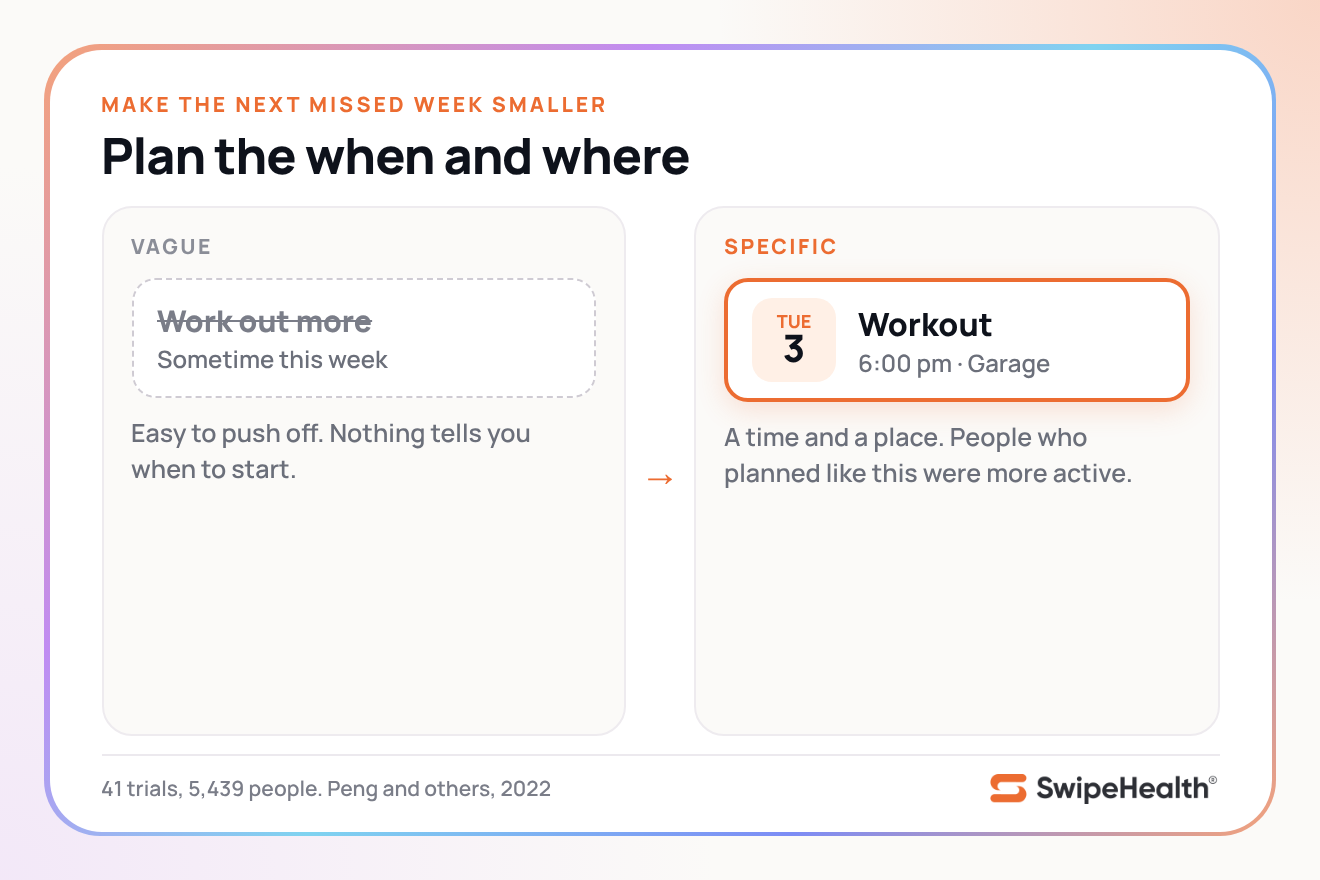
Plan the when and where. A review of 41 trials with 5,439 people found that people who made a simple plan for when and where they'd exercise were more active. When researchers combined the results of 35 of the trials, the boost was small to medium.[4] Write "Tuesday, 6 pm, garage" in your calendar, not just "work out more."
Keep a minimum workout for busy weeks. You can hold on to your strength with much less work than it took to build. In one review, younger adults kept their strength and muscle for up to 32 weeks with one strength workout a week and one set of each exercise. The catch: the weights had to stay heavy. Older adults may need up to two workouts a week with 2 or 3 sets to keep their muscle.[5]

Short is fine. 20 minutes is better than zero.
Don't let one miss turn into a month. In a study of how habits form, missing one chance to do a new habit did not really hurt people's progress.[6] But people who skipped a lot didn't build the habit. So one missed day isn't the problem. Letting misses stretch on is.
The best program in the world is the one you'll stick with. So skip the brutal comeback workout, start small and build momentum.
Your one step for this week
Open your calendar and block 30 minutes in the next two days for your first workout back. That's the whole goal for this week.
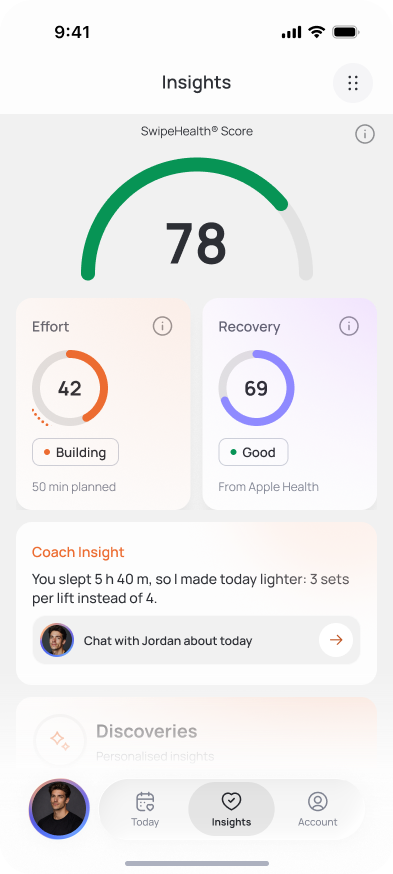
If you use SwipeHealth, your AI coach notices when you've been away and checks in. After about 10 days off, Marcus keeps your same exercises, goes a bit lighter with one fewer set, and trims the workout to about 40 minutes instead of 60. Then he builds you back to your normal weights over your next three workouts.

"It's not like you're starting over from dead zero. Muscle memory is elastic, right? You're going to bounce back more than you think you will once you get in there."
What the research says
Short breaks cost little. Moderate evidence: a review of studies on short breaks.[1] Strong evidence: a meta-analysis of 103 studies.[2]
Strength returns fast. Moderate evidence: one trial where 55 people started and 42 finished.[3]
Planning and a busy-week minimum help. Moderate evidence: a review of 41 randomized trials with 5,439 people.[4] Moderate evidence: a review of the smallest amount of training that keeps strength.[5] Early research: one study where people tracked their own habits.[6]
AI coach tip
Try this next
"In the app, when you've been away, I don't restart your plan. I bring the weights down a notch for your first workout back and build back over your next three. Tell me what happened and we'll go from there."
Marcus, AI coach



Follow The Warm Up
Maya, Jordan and Marcus, the SwipeHealth® AI coaches, talk through our articles and guides on the podcast. New episodes come out with new pieces.
Read the transcript
Maya: This is The Warm Up with SwipeHealth. I'm Maya, one of the AI coaches inside the SwipeHealth app, and Marcus is here with me.
Marcus: Hey, everyone.
Maya: You missed a week, maybe two, and now you're wondering if it's all gone.
Marcus: It isn't. Not even close. Today we're talking about what to do after a break, and the short answer is simple. Do your next workout in the next two days. Same exercises, a little lighter, and stop each set while you could still do a few more reps.
Maya: Let's start with the fear. People feel like two weeks off means starting from scratch.
Marcus: And the research says otherwise. A review of short breaks, under four weeks, found strength drops only a little in that time.
Maya: Cardio slips a bit faster. That's how long you can keep going before you're out of breath. The drop was biggest in highly trained athletes and milder in people who were newer to training.
Marcus: The real cost is time. A big analysis of 103 studies found that the longer people stopped, the more strength and power they lost. People over 65 lost more.
Maya: So getting back soon matters more than getting back perfect.
Marcus: Here's my favorite part. In a 2024 study, 55 adults who didn't lift were split into two groups. One group lifted for 10 weeks, stopped for 10 weeks, then lifted for 10 more.
Maya: The other group waited 10 weeks, then lifted for 20 weeks straight. Both trained twice a week.
Marcus: The break group lost some strength and muscle while they were off. But in their first 5 weeks back, they gained leg strength and muscle faster than the other group did in its first 5 weeks.
Maya: And after 30 weeks, both groups ended up about the same.
Marcus: That break was 10 weeks. Yours was probably shorter, so it should be an even smaller bump.
Maya: Okay, Marcus. Someone's back on Monday. What do they do?
Marcus: First workout, same exercises as before. Go a bit lighter than where you stopped, do one fewer set than usual, and stop each set with two or three reps left.
Maya: Second workout, a day or two later?
Marcus: Same exercises. If the first one felt easy, add a little weight. Third workout, go back to your normal weights if you feel good. If not, repeat the second one.
Maya: And by week two, it's your usual routine. Also, pick up where you left off. If you missed leg day, do leg day next. Your plan doesn't have to restart on Monday.
Marcus: Some soreness is normal. Sharp pain, joint pain or feeling dizzy is not, so stop and get it checked. And if your break was because you were sick or hurt, check with your doctor before you start back.
Maya: Your perfect week is going to break again. Work trips, sick kids, long days. The goal is to keep the next break short.
Marcus: Three things help. One, plan the when and where. A review of 41 trials found people who planned a time and place for exercise were more active. Write "Tuesday, 6 pm, garage," not "work out more."
Maya: Two, keep a busy-week minimum. In younger adults, one strength workout a week with one set of each exercise held strength and muscle for up to 32 weeks. The catch is the weights had to stay heavy. Older adults may need up to two workouts a week.
Marcus: Three, don't let one miss turn into a month. In a study on how habits form, missing one day didn't really hurt progress. Letting misses stretch on did.
Maya: So here's your one step. Open your calendar and block 30 minutes in the next two days for your first workout back.
Marcus: And if you use SwipeHealth, tell me or Maya you've been away. We won't restart your plan. We'll bring the weights down a notch and build you back up over your next three workouts.
Maya: The full plan and every source are in the article on swipehealth.ai.
Marcus: See you next time.
Start your free trial.
Your workouts adapt to your day, your energy and your goals. Try SwipeHealth free.
Start your free trialQuestions people ask
Is it bad to miss a week of working out?
No. The bigger risk is letting one week turn into several.
How much strength do you lose in two weeks?
Not much.[1] And it comes back fast.[3]
Should I start back at my old weights?
Start a bit lighter, stop each set with 2 or 3 reps left, and work back up over your first few workouts.
How long does it take to get back to where I was?
It varies with how long you were off. Longer breaks cost more strength, so the sooner you start back, the less you have to rebuild.[2]
I keep falling behind. Is it worth starting again?
Yes. One missed day isn't what breaks a habit. A long run of missed days is, so the next workout is the one that counts.[6]
References
- Mujika I, Padilla S. Detraining: loss of training-induced physiological and performance adaptations. Part I: short term insufficient training stimulus. Sports Medicine. 2000;30(2):79-87. https://pubmed.ncbi.nlm.nih.gov/10966148/
- Bosquet L, Berryman N, Dupuy O, Mekary S, Arvisais D, Bherer L, Mujika I. Effect of training cessation on muscular performance: a meta-analysis. Scandinavian Journal of Medicine and Science in Sports. 2013;23(3):e140-e149. https://doi.org/10.1111/sms.12047 (record: https://lida.sport-iat.de/ta/Record/4060183)
- Halonen EJ and others. Does taking a break matter: adaptations in muscle strength and size between continuous and periodic resistance training. Scandinavian Journal of Medicine and Science in Sports. 2024;34(10):e14739. https://pubmed.ncbi.nlm.nih.gov/39364857/
- Peng S, Othman AT, Yuan F, Liang J. The effectiveness of planning interventions for improving physical activity in the general population: a systematic review and meta-analysis of randomized controlled trials. IJERPH. 2022;19(12):7337. https://www.mdpi.com/1660-4601/19/12/7337
- Spiering BA, Mujika I, Sharp MA, Foulis SA. Maintaining physical performance: the minimal dose of exercise needed to preserve endurance and strength over time. Journal of Strength and Conditioning Research. 2021;35(5):1449-1458. https://pubmed.ncbi.nlm.nih.gov/33629972/
- Lally P, van Jaarsveld CHM, Potts HWW, Wardle J. How are habits formed: modelling habit formation in the real world. European Journal of Social Psychology. 2010;40(6):998-1009. https://doi.org/10.1002/ejsp.674 . University College London news release on the study, 2009: https://www.ucl.ac.uk/news/2009/aug/how-long-does-it-take-form-habit
Related reading
Bring this kind of coaching to the people you serve
See how SwipeHealth works for your building, gym, clinic or company.
Get The Warm Up
One email a month with our best new articles and guides, plus what's new in the app.