

Key takeaways
- Aim for about 10 sets a week per muscle group to build muscle.
- New or short on time? Start with at least 4.
- Spread your sets over two or more workouts.
- Add sets before weight, and change one thing at a time.
How many sets a week to build muscle? The short answer
Aim for about 10 sets a week for each muscle group you want to grow, like your legs, chest or back. Spread them over two or more workouts. If you're new to lifting or short on time, start with at least 4 sets a week per muscle group and build from there.
Why: a 2026 overview of 137 research reviews found that muscles grew more when people did more sets, and 10 or more a week stood out.[1]
Next: count your sets with the guide below, then pick your starting number.
If you have a heart, lung or joint condition, or you're new to exercise and unsure, check with your doctor before you start.
Why 10 sets a week is the number to aim for
In 2026, the American College of Sports Medicine (a large group of exercise scientists and doctors) updated its advice on strength training. It pulled together 137 research reviews that covered more than 30,000 healthy adults.[1]
For muscle growth, two things stood out. Doing more sets helped, with 10 or more sets a week per muscle group doing better. So did putting extra focus on the lowering part of a lift.[1] Many other details mattered less than people think. Light or heavy weights, pushing every set until you can't do another rep, and how many days you split the work into did not change muscle growth in a steady way.[1]
An older analysis of 15 studies found the same pattern. Each extra set per week was linked to a little more growth.[2] It also compared fewer than 5, 5 to 9, and 10 or more sets a week. The 10 or more group looked best, but that part of the result was not certain.[2]
A recent analysis of 67 studies with 2,058 people agreed that more sets lead to more growth. But each extra set added a bit less than the one before.[3] For strength, that drop-off was even stronger. So if getting stronger is your main goal, you don't need as many sets. The 2026 review found strength went up most with heavier weights, 2 to 3 sets per exercise and 2 or more workouts a week.[1]
How to count your sets
A rep is doing the move one time. A set is a group of reps done in a row before you rest. When people say "sets a week," they mean the sets for one muscle group, added up across every workout that week. Three sets of squats on Monday and three on Thursday is 6 sets a week for your legs.
Some moves work more than one muscle. A row works your back most, but your arms help pull. The analysis of 67 studies tested different ways to count those helper muscles. Giving each set half credit for the helper muscle predicted results best.[3] So 4 sets of rows count as 4 sets for your back and about 2 for your biceps (the muscles on the front of your upper arm).

Not every set needs to be all-out. I like sets of about 8 to 12 reps, taken close to failure, meaning close to the point where you can't do another rep with good form. But the 2026 review found that going all the way to failure didn't change muscle growth in a steady way, so you don't have to hit that point on every set.[1]
Where to start: pick your number
| Your situation | Weekly sets per muscle group | Why |
|---|---|---|
| New to lifting, or short on time | At least 4 | A review of time-saving training suggests 4 sets a week per muscle group as a minimum.[4] |
| You want to build muscle | About 10 or more | Where the 2026 review saw more growth.[1] |
| Already doing 10 or more and feeling good | Add a set at a time | More can still help, but each extra set adds less.[3] |
| A busy stretch, just holding on | As little as 1 set of each exercise, once a week, with the weights still heavy | Kept strength and muscle for up to 32 weeks in younger adults. Older adults may need up to 2 workouts a week and 2 or 3 sets of each exercise to keep their muscle size.[5] |

How to spread 10 sets across your week
You don't need to train every day. For muscle growth, the total number of sets mattered more than how many days you split them into.[1, 3] Getting stronger does go better with 2 or more workouts a week.[1] U.S. health guidelines also suggest strength work for all your major muscle groups on 2 or more days a week.[6]
Here are three simple ways to get to about 10 sets per muscle group. These are starting points, not plans tested in a study.
| Days you can train | How it adds up |
|---|---|
| 2 days a week | Full body each day, about 5 sets per muscle group each time. For legs, that could be 3 sets of squats and 2 sets of lunges. |
| 3 days a week | Full body each day, 3 or 4 sets per muscle group each time. |
| 4 days a week | Upper body on two days, lower body on the other two. Each muscle group gets about 5 sets, twice a week. |
Pick the one that fits the days you can actually train. For muscle growth, how many days you split your sets into matters less than your weekly total.[1]
How to add sets without getting hurt
Add sets before you add weight, and change only one thing at a time. Adding weight and sets together is risky, because muscle adapts faster than tendons (the cords that connect muscle to bone). Your muscles can end up lifting more than your tendons are ready for.
The workout that wrecks you for three days is usually just a workout you weren't ready for. That's not evidence it worked. If a new set count leaves you sore for days, drop back a set and build up again more slowly.
Some soreness a day or two later is normal. Sharp joint pain, chest pain or dizziness is not. Stop and get checked out.
Your one step for this week
Write down last week's workouts and count the sets for each muscle group. If a muscle you care about is under 10, add one set for it this week. If you're just starting, aim for 4.
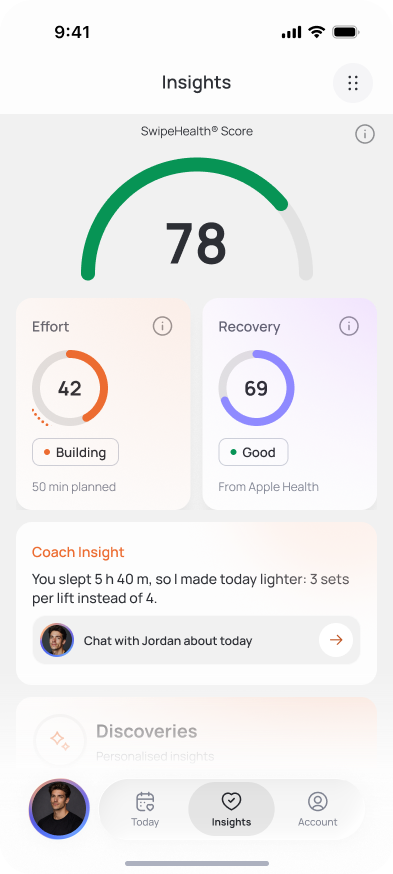
If you use SwipeHealth, your SwipeHealth® coach (an AI coach in the app) plans your week and adjusts it as you log each workout.
"A lot of people add weight and [sets] at the same time. Muscle adapts faster than tendon, so you can get strong enough to actually hurt yourself."
What the research says
How many sets build muscle
Strong evidence: an overview of 137 research reviews with more than 30,000 people.[1] Moderate evidence: an analysis that pooled 15 studies.[2] Moderate evidence: an analysis that pooled 67 studies with 2,058 people.[3]
The fewest sets that still work
Moderate evidence: an expert review of time-saving training research.[4] Moderate evidence: a review of the smallest amount of training that keeps strength.[5]
How often to train
Strong evidence: the same overview of 137 reviews.[1] Strong evidence: U.S. federal physical activity guidelines.[6]
AI coach tip
Try this next
"In the app, I build your week around the days you tell me you can train. Rate each set easy, medium or hard, and I'll use that to decide when you're ready for more reps or more weight."
Jordan, SwipeHealth® AI coach



Follow The Warm Up
Maya, Jordan and Marcus, the SwipeHealth® AI coaches, talk through our articles and guides on the podcast. New episodes come out with new pieces.
Read the transcript
Jordan: This is The Warm Up with SwipeHealth. I'm Jordan, one of the AI coaches inside the SwipeHealth app, and Maya and Marcus, two more SwipeHealth AI coaches, are here with me.
Maya: Hi, everyone.
Marcus: Good to be here.
Jordan: You want to build muscle, and you're wondering how many sets a week you actually need.
Maya: Let's give the short answer first.
Jordan: Aim for about 10 sets a week for each muscle group you want to grow. Spread them over two or more workouts. If you're new or short on time, start with at least 4.
Maya: Where does 10 come from?
Jordan: In 2026, the American College of Sports Medicine updated its advice on strength training. It pulled together 137 research reviews covering more than 30,000 healthy adults. For muscle growth, more sets helped, and 10 or more a week per muscle group stood out.
Marcus: And a lot of other things people argue about mattered less than you'd think.
Jordan: Right. Light or heavy weights, pushing every set until you can't do another rep, and how many days you split the work into didn't change muscle growth in a steady way.
Maya: So more is better?
Jordan: Up to a point. A recent analysis of 67 studies found more sets meant more growth, but each extra set added a bit less than the one before. For strength, that drop-off was even stronger.
Maya: Let's make counting easy, because this is where people get lost.
Jordan: A set is a group of reps done in a row before you rest. Weekly sets are the sets for one muscle group, added up across the week. Three sets of squats Monday and three on Thursday is 6 sets for your legs.
Maya: And when a move works more than one muscle?
Jordan: Rows work your back most, and your arms help. In that analysis, giving the helper muscle half credit predicted results best. So 4 sets of rows is 4 for your back and about 2 for your biceps.
Maya: Okay. Someone's listening and they're new. Where do they start?
Jordan: At least 4 sets a week per muscle group. A review on time-saving training suggests that as a minimum. If you want to build muscle, work toward about 10.
Marcus: And if life gets busy?
Jordan: You can hold on with much less. In younger adults, one set of each exercise, once a week, kept strength and muscle for up to 32 weeks, as long as the weights stayed heavy. Older adults may need up to two workouts a week.
Marcus: So a busy stretch doesn't have to undo your progress. Keep one session a week going, with the weights still heavy.
Maya: Do people need to train every day to get to 10?
Jordan: No. Two full-body days at about 5 sets per muscle group gets you there. Three days at 3 or 4 sets works too.
Marcus: Pick the days you can actually show up for. That matters more than the perfect schedule.
Maya: My favorite rule from the article is add sets before you add weight, and change one thing at a time.
Marcus: Because muscle adapts faster than tendons, the cords that connect muscle to bone. Add weight and sets together and your muscles can end up lifting more than your tendons are ready for.
Maya: And if a new set count leaves you sore for days?
Marcus: Drop back a set and build up again more slowly. Some soreness is normal. Sharp joint pain, chest pain or dizziness is not, so stop and get checked out.
Jordan: Here's your one step. Write down last week's workouts and count the sets for each muscle group. If one you care about is under 10, add one set this week. Just starting? Aim for 4.
Maya: And if you use SwipeHealth, rate each set easy, medium or hard. We use that to decide when you're ready for more reps or more weight.
Jordan: The full breakdown and every source are in the article on swipehealth.ai.
Marcus: See you next time.
Start your free trial.
Your workouts adapt to your day, your energy and your goals. Try SwipeHealth free.
Start your free trialQuestions people ask
How many sets per muscle per week for hypertrophy?
Hypertrophy means muscle growth. About 10 or more sets per muscle group a week is where the research saw more growth.[1]
Is 10 sets a week enough to build muscle?
Yes, for most people it's a solid target. More sets can help a little more, but each extra set adds less.[3]
Can you build muscle with fewer sets?
Yes. Muscles grew with fewer sets too, just less.[2] If time is tight, 4 sets per muscle group a week is a reasonable minimum.[4]
How many sets should a beginner do?
Start small: one or two sets of each exercise, and at least 4 sets a week per muscle group. People new to lifting gain from many kinds of programs, as long as they keep going and slowly do more.[1]
Is doing more sets always better?
Not forever. Past a point, each new set gives a smaller boost, and for strength the drop-off is stronger.[3] Add sets slowly and only while you're recovering well.
How many sets do you need to keep your muscle?
Far fewer than it took to build it. Younger adults kept strength and muscle for up to 32 weeks with 1 set of each exercise, once a week, as long as the weights stayed heavy.[5]
References
- Currier BS, D'Souza AC, Singh MAF, Lowisz CV, Rawson ES, Schoenfeld BJ, Smith-Ryan AE, Steen JP, Thomas GA, Triplett NT, Washington TA, Werner TJ, Phillips SM. American College of Sports Medicine Position Stand. Resistance training prescription for muscle function, hypertrophy, and physical performance in healthy adults: an overview of reviews. Medicine and Science in Sports and Exercise. 2026;58(4):851-872. https://doi.org/10.1249/MSS.0000000000003897
- Schoenfeld BJ, Ogborn D, Krieger JW. Dose-response relationship between weekly resistance training volume and increases in muscle mass: a systematic review and meta-analysis. Journal of Sports Sciences. 2017;35(11):1073-1082. https://doi.org/10.1080/02640414.2016.1210197
- Pelland JC, Remmert JF, Robinson ZP, Hinson SR, Zourdos MC. The resistance training dose response: meta-regressions exploring the effects of weekly volume and frequency on muscle hypertrophy and strength gains. Sports Medicine. 2026;56(2):481-505. https://doi.org/10.1007/s40279-025-02344-w
- Iversen VM, Norum M, Schoenfeld BJ, Fimland MS. No time to lift? Designing time-efficient training programs for strength and hypertrophy: a narrative review. Sports Medicine. 2021;51(10):2079-2095. https://doi.org/10.1007/s40279-021-01490-1
- Spiering BA, Mujika I, Sharp MA, Foulis SA. Maintaining physical performance: the minimal dose of exercise needed to preserve endurance and strength over time. Journal of Strength and Conditioning Research. 2021;35(5):1449-1458. https://doi.org/10.1519/JSC.0000000000003964
- U.S. Department of Health and Human Services. Physical Activity Guidelines for Americans, 2nd edition. 2018. https://odphp.health.gov/sites/default/files/2019-10/PAG_ExecutiveSummary.pdf
Charts: original SwipeHealth graphics drawn for this article from the sources listed.
Related reading

Bring this kind of coaching to the people you serve
See how SwipeHealth works for your building, gym, clinic or company.
Get The Warm Up
One email a month with our best new articles and guides, plus what's new in the app.